
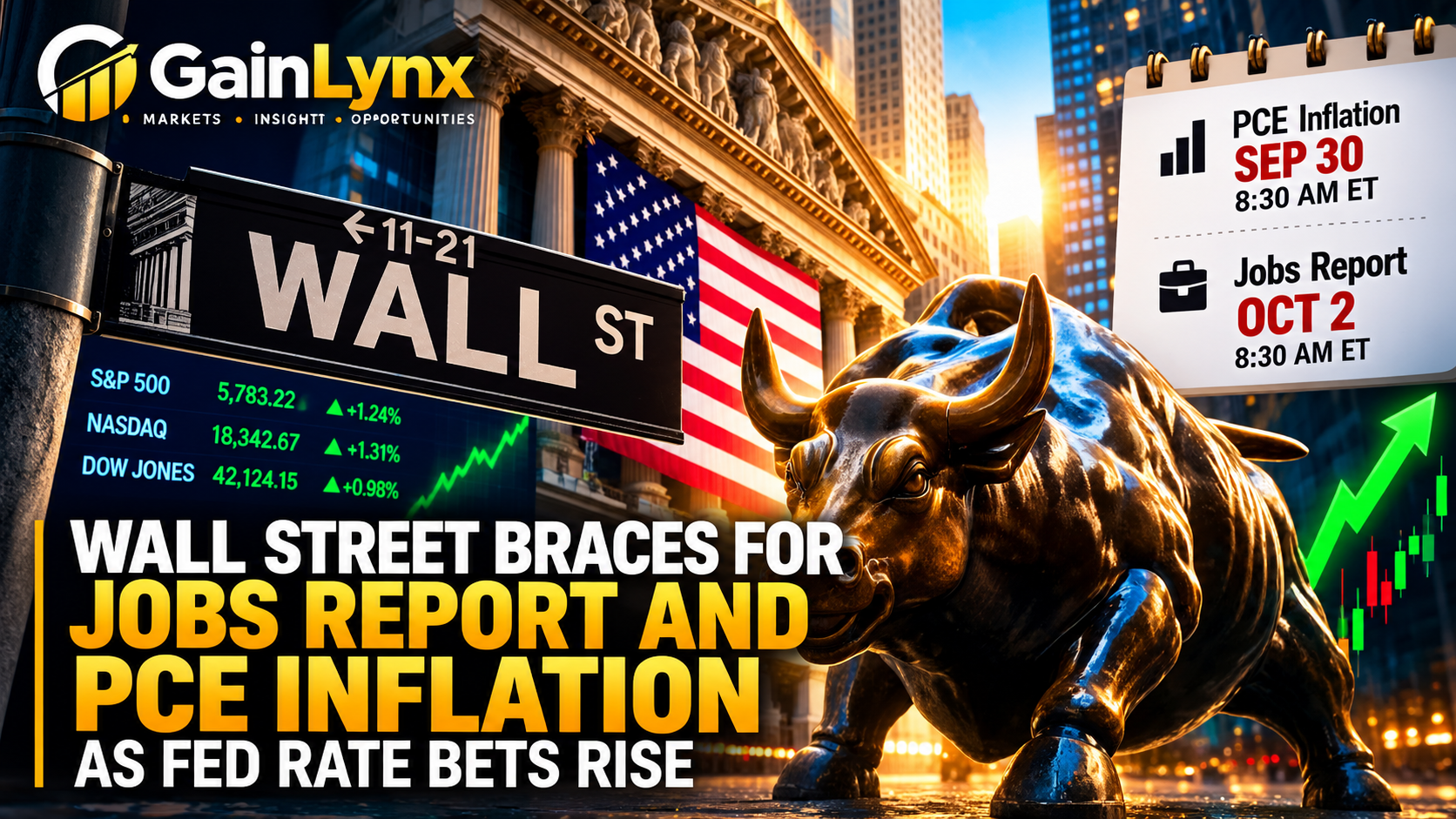

Wall Street is heading into a crucial week for U.S. markets, with two major economic releases set to shape expectations for Federal Reserve policy: the August Personal Consumption Expenditures inflation report and the September jobs report.
Investors will be watching both releases closely as Treasury yields remain elevated and markets assess whether the Federal Reserve may need to continue tightening monetary policy.
US Jobs Report and PCE Inflation Take Center Stage
The U.S. Bureau of Economic Analysis is scheduled to release its August Personal Income and Outlays report on Wednesday, September 30 at 8:30 a.m. ET. The report includes the closely watched PCE price index.
Two days later, the U.S. Bureau of Labor Statistics is scheduled to publish the September Employment Situation report on Friday, October 2 at 8:30 a.m. ET.
Together, the two reports could provide investors with important clues about inflation, labor-market strength and the outlook for U.S. interest rates.
Wall Street Expects 100,000 New Jobs
A Reuters poll of economists expects the September employment report to show approximately 100,000 new jobs, while the unemployment rate is forecast at 4.2%.
A stronger-than-expected jobs report could reinforce expectations that the Federal Reserve has room to maintain a tighter monetary-policy stance. A weaker report, however, could reduce some of those expectations if it points to a cooling labor market.
PCE Inflation Could Shape the Fed Debate
The PCE price index will be another major focus for investors. In the previous report for July, the headline PCE price index increased 0.2% from the prior month and 3.7% from a year earlier.
Core PCE, which excludes food and energy, also increased 0.2% on a monthly basis and was up 3.3% from a year earlier.
With inflation still running above the Federal Reserve’s 2% objective, markets will be looking for signs that price pressures are beginning to cool or remain persistent enough to support further monetary tightening.
Fed Rate-Hike Expectations Remain in Focus
The Federal Reserve raised interest rates by 25 basis points on September 16, its first increase in three years, as policymakers continued their effort to contain inflation.
According to LSEG data cited by Reuters, Fed Funds futures on Thursday indicated a greater than 60% probability of another rate increase at the Federal Reserve’s next meeting in October.
Those expectations could shift quickly depending on the upcoming employment and inflation numbers.
Treasury Yields Add Pressure to Stocks
Rising U.S. government bond yields are another important factor for equity investors.
Higher Treasury yields can increase borrowing costs for companies and consumers while also making fixed-income assets more competitive with equities for investor capital.
That relationship makes the bond market especially important as investors evaluate how much additional tightening the Federal Reserve may deliver.
Wall Street Remains Close to Record Levels
Despite concerns about interest rates, major U.S. equity indexes have remained near historically high levels, supported in part by technology and artificial-intelligence-linked stocks.
Reuters reported that the S&P 500 was just over 1% below its mid-August peak on Thursday.
However, performance beneath the headline index has been less uniform. Nine of the S&P 500’s 11 sectors were in negative territory for September at the time of the Reuters report, while an equal-weight version of the index was down about 4% for the month.
This divergence suggests that investors may be watching not only the direction of the major indexes, but also whether market participation begins to broaden.
What Investors Should Watch Next
- September 30: August Personal Income and Outlays and PCE inflation data.
- October 2: September U.S. Employment Situation report.
- Federal Reserve expectations: Changes in market pricing for another interest-rate increase.
- Treasury yields: Whether bond yields continue to rise following the economic data.
- Wall Street breadth: Whether gains expand beyond technology and AI-linked stocks.
Market Outlook
A softer inflation reading combined with moderate employment growth could ease some pressure on Treasury yields and expectations for additional Federal Reserve tightening.
In contrast, persistent inflation or a much stronger-than-expected jobs report could reinforce expectations that policymakers will need to keep monetary policy restrictive.
With Wall Street near record levels and investors focused heavily on the path of interest rates, the upcoming PCE and employment reports could become important catalysts across stocks, bonds and the U.S. dollar.
Sources
- Reuters — Wall St Week Ahead: Jobs report, inflation data to test U.S. rate path and economic strength
- U.S. Bureau of Economic Analysis — Official Release Schedule
- U.S. Bureau of Economic Analysis — Personal Income and Outlays, July 2026
- U.S. Bureau of Labor Statistics — Employment Situation Release Schedule
Disclaimer: This article is for informational purposes only and does not constitute financial or investment advice. Market conditions can change rapidly, and readers should conduct their own research before making financial decisions.
