
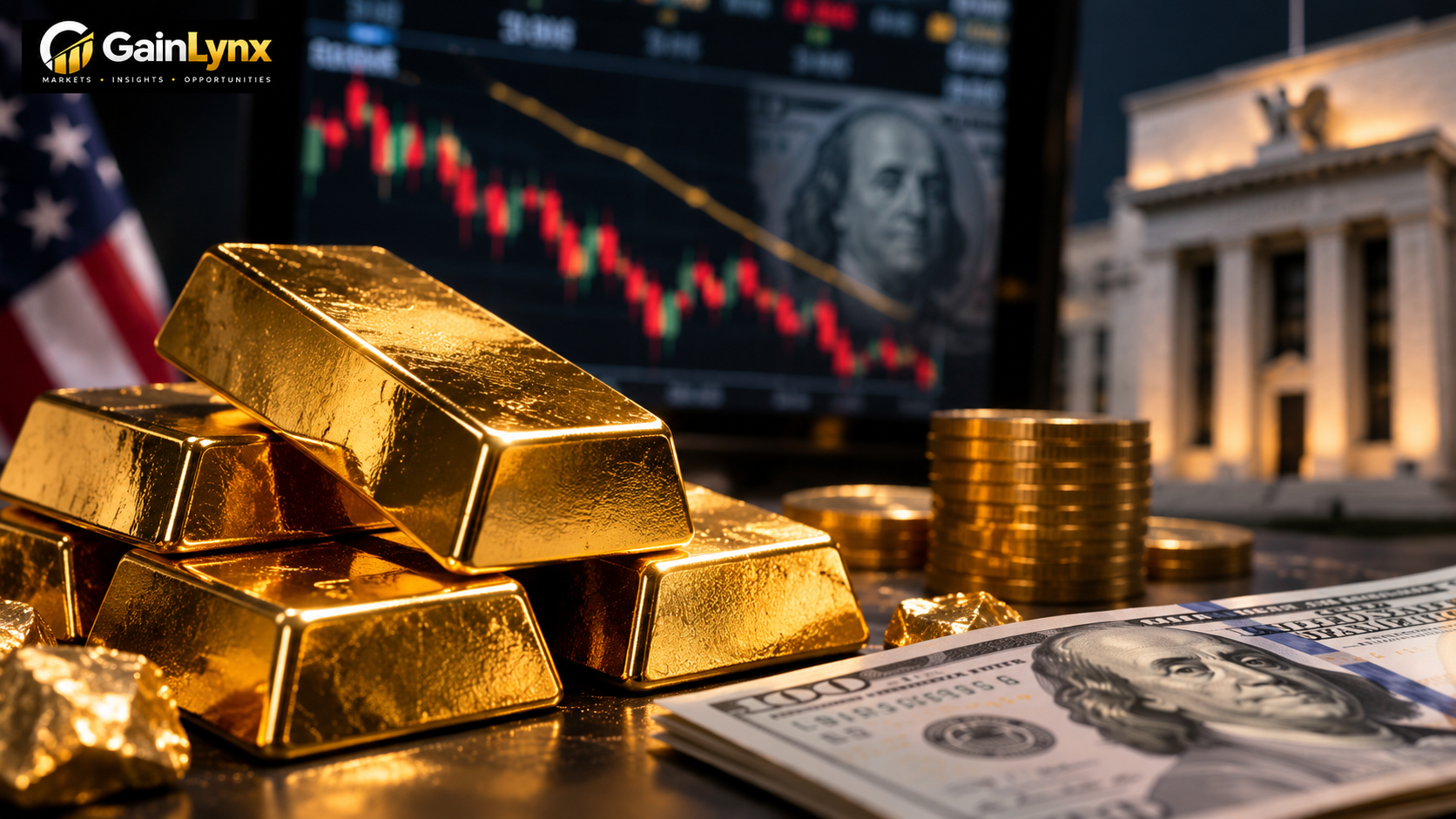

Gold prices remained near their lowest level in more than a year on Tuesday, November 17, 2026, as a powerful U.S. dollar and growing expectations of another Federal Reserve interest rate increase continued to pressure the precious metal.
Spot gold recovered modestly to $3,874.41 per troy ounce by 06:34 GMT on Tuesday, according to Reuters, after falling to $3,830.74 during Monday’s session. That earlier decline marked gold’s lowest level since October 2, 2025.
The rebound offered some relief following the sharp sell-off, but the broader market remained focused on U.S. Treasury yields, the Federal Reserve’s policy outlook, and the strength of the dollar.
Gold Prices Recover Slightly After Sharp Monday Sell-Off
Gold’s latest price action reflects an increasingly difficult environment for non-yielding assets.
On Monday, bullion dropped to $3,830.74 an ounce, approximately 31.5% below its January record of $5,594.82, according to a Reuters analysis.
By early Tuesday, spot gold had gained 0.5% to $3,874.41 an ounce, while U.S. gold futures for December delivery rose 0.6% to $3,876.70.
Although the recovery suggested some buying interest near recent lows, it did not eliminate the broader pressure created by tighter monetary policy expectations.
For investors, the central question is whether gold can stabilize above the psychologically important $3,800 level or face renewed selling if the dollar and bond yields continue rising.
Why Is the U.S. Dollar Pressuring Gold?
The U.S. dollar is one of the most important variables influencing international gold prices.
Gold is typically priced in dollars. When the dollar strengthens, the metal becomes more expensive for buyers using other currencies, potentially reducing international demand.
Reuters reported that the dollar reached a fresh 19-month high on Tuesday, adding to the challenges facing the gold market.
A stronger dollar can also reflect expectations that U.S. interest rates will remain elevated or rise further.
However, the relationship is not perfectly consistent. Gold can sometimes rise alongside the dollar during periods of severe financial stress or geopolitical uncertainty.
Federal Reserve Rate-Hike Expectations Intensify
Investors are increasingly pricing in another Federal Reserve interest rate increase at the central bank’s December meeting.
According to CME FedWatch probabilities cited by Reuters on Tuesday, markets assigned a 95.4% probability to a 25-basis-point increase and a 4.6% probability to a larger 50-basis-point increase.
These figures represent market-implied expectations at a specific point in time, not a confirmed decision by the Federal Reserve.
Higher interest rates tend to create headwinds for gold because the metal does not pay interest or dividends.
When Treasury securities offer more attractive yields, some investors may prefer interest-bearing assets over bullion.
Rising Treasury Yields Add Another Challenge
U.S. Treasury yields are also playing an important role in the recent gold sell-off.
As bond yields increase, the opportunity cost of holding gold rises. Investors who hold bullion receive no periodic income, unlike investors who own interest-paying Treasury securities.
Real yields, which account for inflation expectations, are particularly relevant to the longer-term investment case for gold.
However, gold’s relationship with yields can vary depending on inflation, financial conditions, central-bank purchases, and safe-haven demand.
For this reason, investors should monitor both nominal Treasury yields and inflation-adjusted yields rather than relying on a single indicator.
Gold’s Decline From Its January Record
The recent sell-off follows a dramatic reversal from gold’s record high earlier in 2026.
Reuters reported that bullion reached $5,594.82 per ounce in January before declining sharply during the following months.
Monday’s low represented a drop of approximately 31.5% from that peak.
The scale of the decline illustrates how quickly expectations surrounding monetary policy, inflation, and global liquidity can reshape the outlook for precious metals.
Reuters also reported that gold was on course for its weakest annual performance since 2015 if the prevailing trend persisted. The final annual outcome, however, remains uncertain.
Could Central-Bank Demand Support Gold?
Central-bank buying has been an important source of gold demand, but investors are now assessing whether official-sector purchases will remain strong enough to offset macroeconomic pressure.
According to World Gold Council estimates cited by Reuters, central banks purchased approximately 675 metric tons of gold during the first nine months of 2026.
Meanwhile, physically backed gold exchange-traded funds recorded inflows of 211 metric tons during the third quarter.
These figures indicate that investment and reserve demand have remained meaningful despite rising bond yields.
Nevertheless, central-bank demand is not guaranteed to increase indefinitely, and changes in official purchasing activity could affect market sentiment.
Gold Price Levels to Watch
Following the recent sell-off, several price areas deserve attention.
$3,800: Psychological Support Area
The $3,800 level is an important round-number reference point. Gold remained above this area during Monday’s decline, but a sustained move below it could increase bearish sentiment.
$3,830: Recent Session Low
Monday’s low of $3,830.74 provides a recent market reference. A retest could help traders assess whether selling pressure is easing or intensifying.
$3,875–$3,900: Near-Term Recovery Area
With gold trading around $3,874 early Tuesday, the nearby $3,875–$3,900 area offers a practical zone to monitor for signs of a recovery.
These are observational reference areas rather than independently verified technical support or resistance levels. Their significance may change as new price data becomes available.
Federal Reserve Minutes Could Be the Next Catalyst
Investors are awaiting the minutes of the Federal Open Market Committee’s October 27–28 meeting, scheduled for release on Wednesday, November 18.
The document could provide additional insight into how policymakers assess inflation risks, economic activity, and the need for further interest rate increases.
More hawkish-than-expected signals could reinforce expectations of higher borrowing costs, potentially supporting the dollar and Treasury yields.
Conversely, indications of greater concern about economic weakness or a more cautious approach to rate increases could provide some relief for gold.
Market reactions will depend on how the minutes compare with existing expectations.
What Could Happen Next to Gold Prices?
The near-term outlook depends on several interconnected developments.
Bearish Scenario
If the dollar strengthens further, Treasury yields rise, and the Federal Reserve signals continued tightening, gold could remain under pressure. In that environment, the market may revisit its recent lows.
Recovery Scenario
If Treasury yields retreat or investors reduce expectations of aggressive rate increases, gold could attract renewed buying interest and extend its recovery from Monday’s low.
Volatile Scenario
Unexpected inflation figures, geopolitical developments, or abrupt changes in investor risk appetite could produce sharp price swings in either direction.
These scenarios are illustrative and should not be interpreted as price forecasts or trading recommendations.
Key Takeaways for Gold Investors
- Gold touched $3,830.74 per ounce on November 16, its lowest level since October 2025.
- Spot gold recovered to $3,874.41 by 06:34 GMT on November 17.
- The dollar reached a 19-month high, making dollar-denominated bullion more expensive for international buyers.
- Markets were pricing in a high probability of a December Federal Reserve rate increase.
- Higher Treasury yields continue to raise the opportunity cost of holding non-yielding gold.
- The November 18 Fed meeting minutes could influence the next major market move.
Final Thoughts
Gold’s struggle near a one-year low highlights the powerful influence of U.S. monetary policy on global financial markets.
Although bullion staged a modest recovery on Tuesday, the combination of a stronger dollar, elevated Treasury yields, and expectations of further Federal Reserve tightening remains a significant challenge.
Investors will be watching whether gold can hold above recent lows and whether the upcoming Fed minutes alter expectations for December’s policy decision.
For continuing coverage of precious metals, monetary policy, and financial markets, follow GainLynx.
Sources
- Reuters — Gold Hovers Near More-Than-One-Year Low (November 17, 2026)
- Reuters — Gold Sinks to One-Year Low as Treasury Yields and Dollar Bite (November 16, 2026)
- CME Group — FedWatch Tool
- Federal Reserve — FOMC Calendars and Meeting Information
Market data reflects the reporting times specified above and may have changed since publication. This article is for informational purposes only and does not constitute investment advice.
