
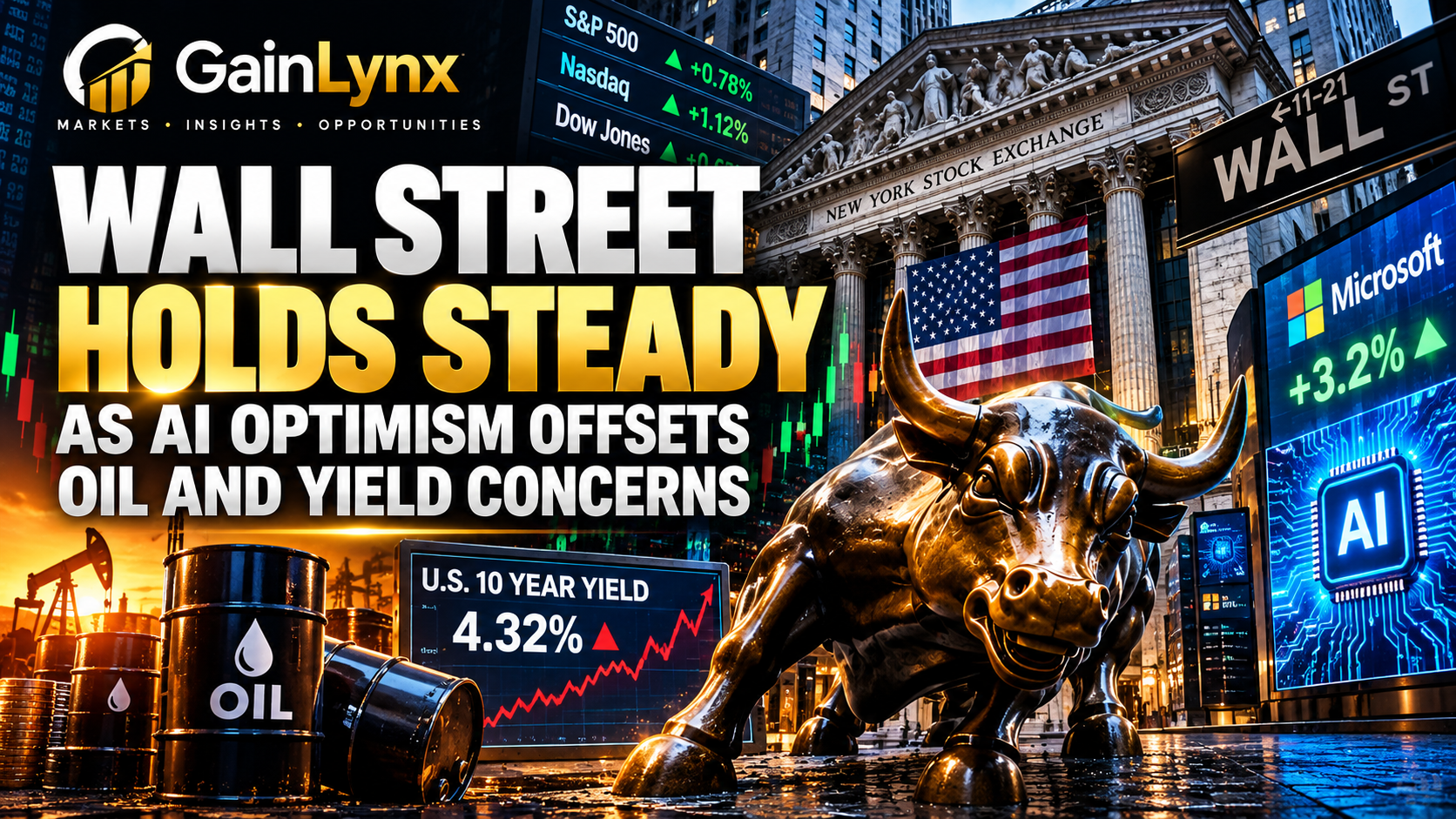

Wall Street traded near the flat line on Friday as renewed optimism around artificial intelligence helped investors look past concerns about elevated oil prices, Treasury yields and the outlook for U.S. interest rates.
The relatively steady session comes after a volatile period for global markets, with investors balancing enthusiasm around technology and artificial intelligence against inflation risks, geopolitical uncertainty and higher borrowing costs.
Wall Street Finds Support From AI Optimism
Artificial intelligence remained an important source of support for U.S. equities on Friday. Technology shares have played a major role in recent market moves as investors continue to assess the potential impact of AI investment on corporate earnings and economic growth.
The renewed enthusiasm comes after a strong start to the week for technology stocks. Earlier in the week, the Nasdaq reached a record closing high as several AI-linked companies rallied and Treasury yields retreated from recent highs.
That strength has helped offset some of the pressure coming from other parts of the market, particularly energy prices and government bond yields.
Oil Prices and Treasury Yields Remain in Focus
Despite optimism around technology stocks, investors remain cautious about elevated oil prices and Treasury yields.
Higher energy prices can increase inflationary pressure by raising transportation, manufacturing and consumer costs. At the same time, higher Treasury yields can make borrowing more expensive and reduce the relative attractiveness of equities, particularly growth stocks whose valuations depend heavily on future earnings.
The combination has created a difficult environment for investors as markets attempt to determine whether inflation can return toward the Federal Reserve’s target without significantly weakening economic growth.
Federal Reserve Outlook Adds Another Layer of Uncertainty
Interest rates remain another major factor influencing Wall Street.
The Federal Reserve raised its benchmark interest rate earlier in September as policymakers continued their effort to control persistent inflation. Recent comments from Federal Reserve officials have also highlighted continued concern about price pressures.
As a result, traders are closely monitoring incoming economic data for clues about whether additional monetary tightening could be required.
Jobs and Inflation Data Could Drive the Next Market Move
Attention is already shifting toward a series of important U.S. economic reports expected in the coming week.
Employment and inflation figures could provide investors with a clearer picture of the strength of the U.S. economy and the direction of monetary policy.
A stronger-than-expected labor market or renewed inflation pressure could reinforce expectations that interest rates may remain elevated. Softer data, on the other hand, could change expectations surrounding the Federal Reserve’s next steps.
That makes the upcoming data particularly important for stocks, bonds, currencies and commodities.
What Investors Are Watching Next
For now, Wall Street is being pulled between competing forces. Artificial intelligence continues to support sentiment toward technology companies, while elevated oil prices, Treasury yields and inflation concerns remain potential headwinds.
Investors will therefore be watching several factors closely, including movements in the U.S. 10-year Treasury yield, crude oil prices, upcoming employment and inflation reports, and comments from Federal Reserve officials.
With these forces moving simultaneously, volatility could remain elevated as markets reassess expectations for economic growth, inflation and interest rates.
Sources
Disclaimer: This article is for informational purposes only and does not constitute financial or investment advice.
